

Wednesday, 4:00 p.m. The presentation for Friday is half done, and there are still three appointments on the calendar. My heart is racing, my shoulders are rising toward my ears, and lunch is out of the question. My body is preparing for a battle that isn’t even going to happen.
An Emergency System that Doesn’t Differentiate
In 1915, physiologist Walter Cannon described this reaction as “fight or flight.” When the brain perceives a threat, it activates the sympathetic nervous system, and the adrenal medulla releases adrenaline. Within seconds, heart rate, blood pressure, and respiratory rate increase; the muscles receive energy; and digestion is shut down. Everything that does not serve survival in the immediate moment is put on hold.
Cannon also coined the term “homeostasis,” building on Claude Bernard’s idea of a stable internal environment. The body is designed to return to equilibrium after a period of arousal. This is the job of the parasympathetic nervous system, the counterpart to the sympathetic nervous system: it lowers the heart rate and blood pressure and switches the body’s focus to digestion and recovery.
The Second Wave: Cortisol
A second pathway kicks in somewhat more slowly. The hypothalamus sends a signal to the pituitary gland, which in turn stimulates the adrenal cortex. The adrenal cortex produces cortisol. It keeps blood sugar levels high so that energy remains available and suppresses inflammatory responses. Through a feedback mechanism, it also curtails its own release as soon as the situation calms down.
Hans Selye began investigating in 1936 why this system is triggered just as readily by a tax assessment as by a real danger. He observed that the body reacts to very different types of stress with a similar basic pattern. The stress response is nonspecific; it doesn’t distinguish between a predator and a tax deadline.
When the Alarm Won’t Stop
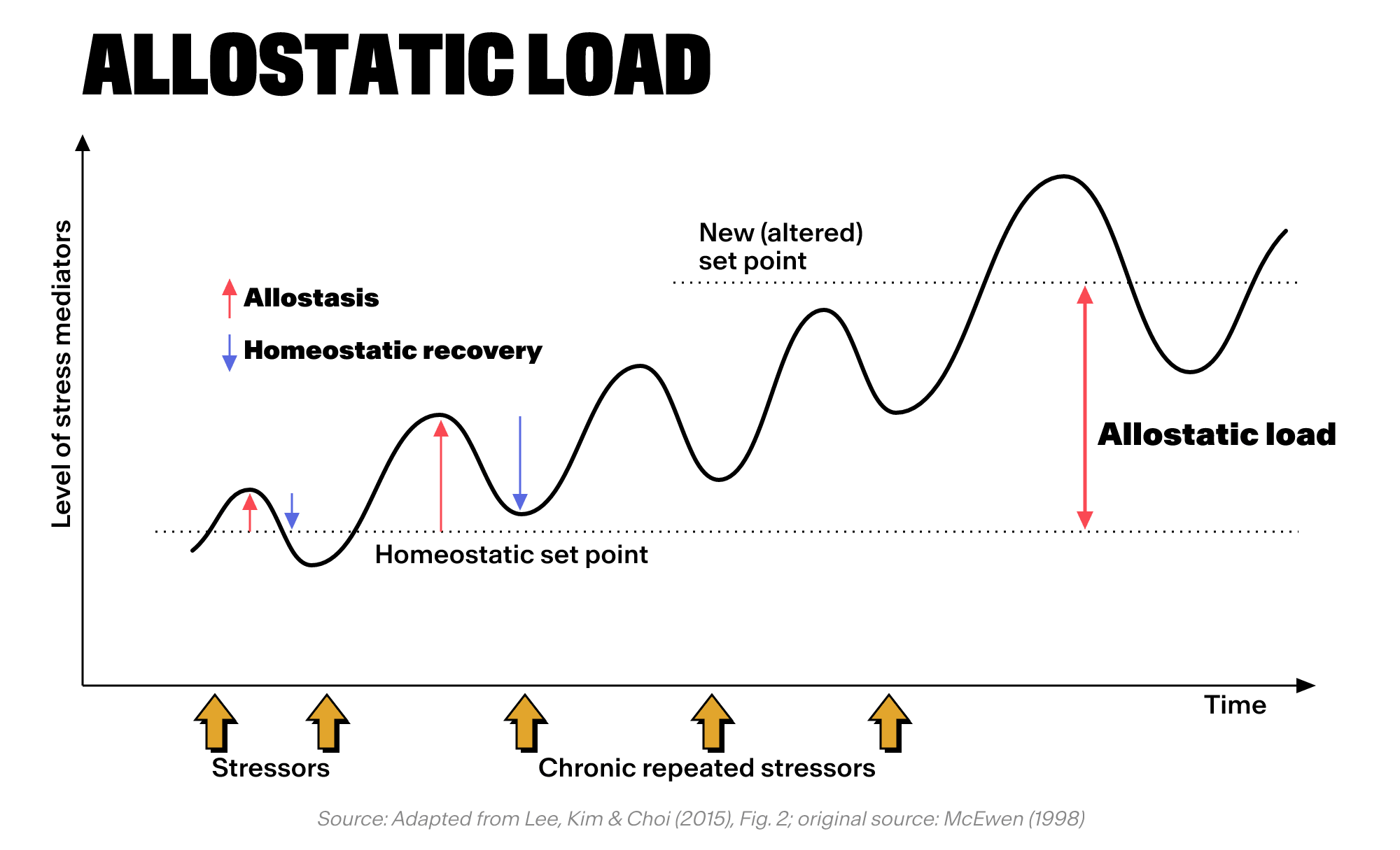
The system is well-designed for brief spikes. Things get difficult when the spikes no longer subside or occur so frequently that there’s no time for recovery in between.
Neuroendocrinologist Bruce McEwen uses two terms to describe this. Allostasis describes how the body remains stable through constant adaptation. Allostatic load is the cost of this adaptation when it becomes a chronic state: the wear and tear that accumulates over months and years, for example in the cardiovascular system, the immune system, and sleep. The deceptive thing about it is that you rarely feel this burden directly. You only realize at some point that resting over the weekend is no longer enough.
Why This Isn’t the Whole Truth
So far, stress sounds like a reflex we’re at the mercy of. But biology only explains how the body reacts. It doesn’t explain why the same deadline leaves one colleague unfazed while keeping another awake at night.
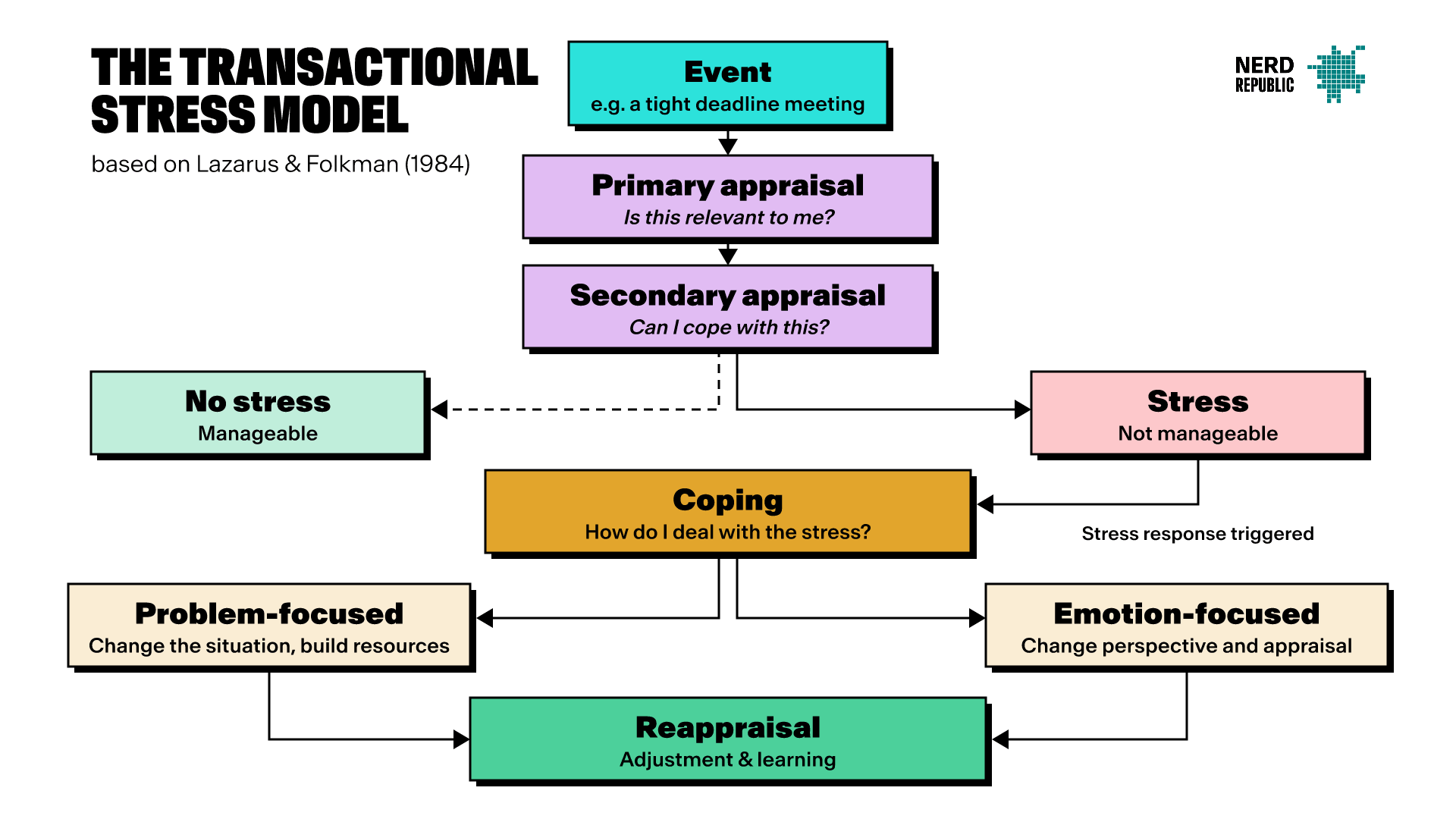
The answer lies one step before the reaction. Richard Lazarus and Susan Folkman have shown that between an event and a stress response lies an assessment: Is this threatening, challenging, or trivial to me? And do I have what I need to deal with it? The sympathetic nervous system only kicks in when this assessment concludes that there is a threat or that the situation is overwhelming.
This assessment even leaves different traces in the body. Jim Blascovich and Wendy Berry Mendes distinguish between a “challenge” state and a “threat” state, which can be measured differently in the cardiovascular system. And Alia Crum, along with colleagues, has shown that even one’s attitude toward stress influences how people experience and cope with it.
We cannot turn off this ancient emergency mechanism. However, the assessment that triggers it can be observed and, to some extent, altered. That is the starting point for everything that follows.
So What Now?
This is exactly where “Navigating Stress,” the new self-paced course from the Nerd Academy, comes in. The course starts with the biology of stress and then moves on to the personal level: how to recognize your stress early on, which internal drivers intensify it, what resources you have, and how recovery actually works. This is where the magic word “coping” comes into play (see the graphic above). Just as personal perceptions vary from person to person, so do coping strategies for dealing with stress. In the Academy course, you’ll learn about some of these strategies that will help you prevent, manage acute episodes of, and recover from chronic stress in your everyday (work) life.
The early bird gets the worm—you’ll receive free access to the course for the first 7 days. After that, it costs a one-time fee of €49 for lifetime access.
Even without course access, you can find out where you currently stand on the homepage. With the Perceived Stress Scale-10, you’ll answer a short questionnaire about your perceived stress over the past month.